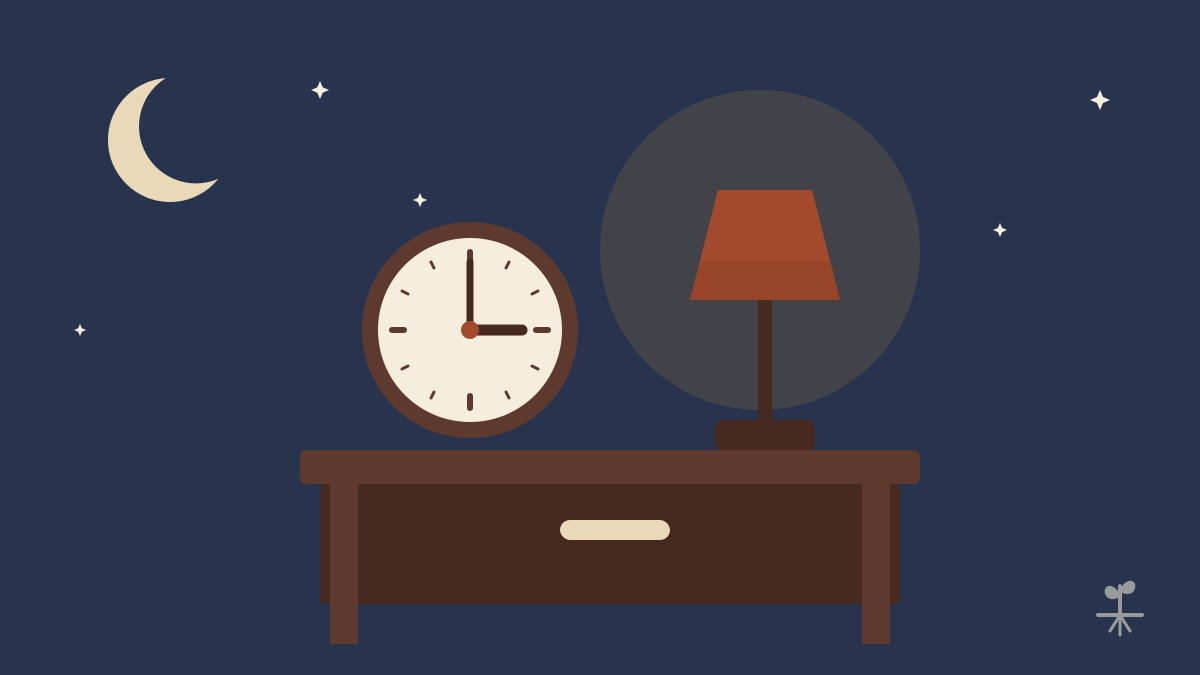
There is a particular quality to 3 a.m. The house is silent in a way it never is during the day. The problems that seemed manageable at dinner have grown teeth. And the clock, glowing on the nightstand, seems to be counting down the hours of sleep you are no longer going to get.
If this is familiar, you are in very large company. Waking in the middle of the night is one of the most common sleep complaints among adults over 50, and one of the least discussed, perhaps because it feels like a private failing. It is not. It has ordinary causes, most of them adjustable, and the most important thing to know is that the awakening itself is rarely the problem. The problem is the hour that follows.
Waking up is built in
Sleep is not a single unbroken state. Across the night the brain cycles through lighter and deeper stages, and at the end of each cycle, roughly every ninety minutes or so, there is a brief surfacing. At 25 these surfacings are so short that they are never remembered. With age, sleep becomes lighter and the surfacings become longer and more likely to reach full awareness. The National Institute on Aging describes this fragmentation as a normal change in older adults' sleep.
So the first reframe is this: you did not "wake up when you should not have." You surfaced, as everyone does, and your brain noticed. What matters now is whether the surfacing lasts thirty seconds or ninety minutes.
Why 3 a.m., specifically
The early hours are structurally different from the first part of the night. Deep, slow-wave sleep is concentrated in the first few cycles; by the second half of the night, sleep is mostly lighter stages and dreaming sleep, from which it is easier to wake. Several other things converge around that hour.
- The clock runs earlier after 50. If your internal rhythm has shifted toward earlier hours, the body may be starting its slow climb toward morning alertness at 3 or 4 a.m. rather than at 6.
- Alcohol wears off. A glass or two of wine with dinner may bring sleep on faster, but as the body finishes processing it, sleep often becomes lighter and more restless, typically in the early hours. Many people who "sleep fine but wake at 3" are describing exactly this pattern.
- The bladder speaks. Needing to urinate at night becomes more common with age for both women and men. If the trip to the bathroom is what wakes you, the goal is to make it as boring as possible: a dim night-light, no bright bathroom light, no phone.
- Temperature drifts. The body's core temperature is at its lowest in the early hours, and a room or bedding that was comfortable at 11 p.m. may be too warm or too cold by 3 a.m. Women in the years around menopause know this particularly well, since hot flashes and night sweats often arrive on this schedule.
- Pain and stiffness surface. Joints that were fine while moving can protest after hours in one position.
Any one of these can produce a brief awakening. None of them, by itself, needs to produce a lost night.
The loop that turns a wake into a bad night
Here is the sequence that sleep clinicians see over and over. You surface. You glance at the clock. You calculate the hours left and feel a jolt of alarm. Your heart rate rises a little. You start to think about the thing you were trying not to think about. You tell yourself firmly to go back to sleep, which is roughly as effective as telling yourself to stop noticing your tongue. Twenty minutes later you are fully awake, angry, and certain tomorrow is ruined.
Every step of that loop is a fork in the road, and each one can go the other way.
Do not look at the clock. Turn it to face the wall or put it in a drawer. Knowing the time provides no information you can act on at 3 a.m., and it reliably produces the jolt that fuels the loop. Your phone is a clock too, with a bright screen attached.
Expect to wake. People who know that surfacing is normal tend to slip back under quickly. People who regard every awakening as a failure tend to stay up. The expectation itself is part of the mechanism.
Do not try. Sleep is one of the few things that trying harder makes worse. The useful stance is closer to indifference: "I am resting, and sleep will come or it will not." Slow breathing, a body scan from the toes up, or a deliberately boring mental task (listing every street in the town where you grew up) can occupy the mind without stimulating it.
If it is not working, get up. After what feels like twenty minutes of wakefulness, leave the bed. Sit in a dim room with a dull book or a quiet task. Do not turn on bright lights, do not open the laptop, do not start the laundry. Return to bed only when you feel genuinely sleepy. This is the single most consistently supported piece of advice for night waking, and it works precisely because it breaks the association between bed and frustration.
Daytime decisions that show up at night
A good deal of 3 a.m. is decided before 3 p.m. The adjustments below are ordinary, and for many people one or two of them account for most of the problem.
- Caffeine after lunch. Sensitivity to caffeine often increases with age, and a mid-afternoon coffee can still be at work in the early hours. Moving the last cup earlier is the easiest experiment there is.
- Alcohol in the evening. If you drink, try a stretch of nights without it, or with the last glass well before bed, and notice whether the early hours change.
- Late, heavy dinners. A large meal close to bedtime can cause reflux and discomfort in exactly the hours when sleep is lightest.
- Long or late naps. A nap after 3 p.m., or one that runs past thirty minutes, reduces the pressure to sleep at night and makes the early-hours surfacing more likely to stick.
- Not enough daylight. The clock needs a strong morning signal to stay anchored. A day spent entirely indoors leaves the rhythm vague, and a vague rhythm is easier to interrupt.
- Fluids in the last two hours. If the bladder is what wakes you, front-load your water earlier in the day and keep the evening lighter, without becoming dehydrated. A clinician can advise if you take medications that affect this.
The unfinished list
For many people the true engine of 3 a.m. is not the bladder or the wine but the mind. Worries that were suppressed all day surface when there is nothing else to look at. One practical habit: before bed, write down tomorrow's tasks and anything that is nagging at you, on paper, with a rough note of what the next step is. This is not about solving anything. It is about telling the brain that the list exists somewhere other than in your head, so it does not need to be rehearsed at 3 a.m.
If the same worries return night after night, and they are affecting your days as well, that is worth raising with a clinician. Persistent night waking is a common feature of depression and anxiety in adults over 50, and both respond to help.
When to talk with a clinician
Most middle-of-the-night waking is manageable with the habits above. Some is not, and it is worth knowing the difference.
- Trouble staying asleep on several nights a week, for three months or longer, is generally considered chronic insomnia. Clinicians often suggest a structured, non-drug program known as cognitive behavioral therapy for insomnia, which addresses the loop described above directly.
- Loud snoring, gasping, or pauses in breathing noticed by a partner may point to sleep apnea, which is evaluated with a sleep study.
- Waking many times a night to urinate may have causes worth checking, including prostate changes, bladder conditions, blood sugar, or the timing of medications.
- Pain that reliably wakes you, or an uncomfortable urge to move the legs in the evening, has its own set of explanations.
- Mood changes, loss of interest, or persistent worry alongside the sleep problem deserve attention in their own right.
Bring a simple sleep diary to the appointment: what time you went to bed, roughly when you woke and for how long, and what you had to eat and drink in the evening. Two weeks of notes tells a clinician more than a description ever could.
The hour is not the enemy
It helps, oddly, to make peace with 3 a.m. Before electric light, historians note, people in many cultures slept in two stretches with a quiet waking hour between them, used for tending the fire, thinking, or talking softly. Nobody is suggesting a return to that. But the modern assumption that a night must be one seamless block is part of what makes the awakening feel like a catastrophe. It is a surfacing. Most nights, handled calmly, it ends the way it began: quietly.